Increase or decrease font size for easier reading :
A+A-
As mono-cash crop farming makes "ISAN" farmers
prisoners to market forces, many farmers have chosen mixed farming.
Mixed farming - plus fish, pig, poultry and cattle raising - frees farmers from hunger
and empowers them to decide when to sell their produce.
His Majesty the King's theory promotes a new farm management policy based on
allocating 30 % of the farmer's land to fish culture, 30 % to rice growing,
30 % to mixed farming and 10 % to homeyard gardening. The goal is that Thai farmers
achieve self-sufficiency.
Mekong fishes
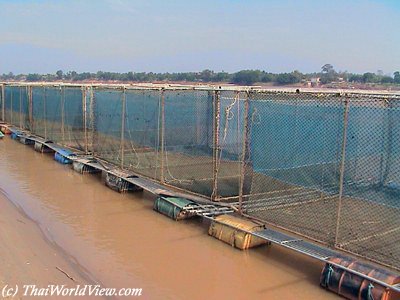
Fish breeding is becoming popular in "ISAN" area. Small fishes are
placed inside empty cages. Fishes are fed until they have grown enough
to be sold. It takes 4 to 5 months to get adult fishes. One cage can contain up to 2500 fishes.
They are sold on Thai markets, sold to factories that freeze
the fishes for export or sold in Laos.
Some farmers have also
transformed their rice fields into a big pond in order
to breed fishes. These ponds can also be used as water storage facilities.
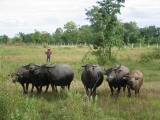
Cattle
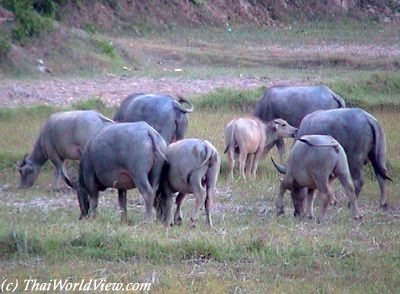
About 400 000 buffaloes are slaughtered
for meat each year. Most are females, many of them pregnant. The males
are kept for their strength and castrated to increase their size and value
as draft animals, which reduces the breeding stock still further.
In "ISAN" area
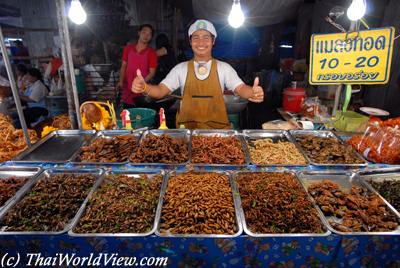
markets, it is possible to eat bugs like scorpions, grasshoppers, larva,
beetles. These days, farmers are making more by harvesting lice than rice.
Bugs seller
Now Bangkok residents also appreciate eating bugs.
Canned grasshoppers, locusts, water beetles, crickets, silkworm pupae and ant eggs are available at
the supermarket. Bangkok residents think of bugs as a healthy, low-calorie treat.
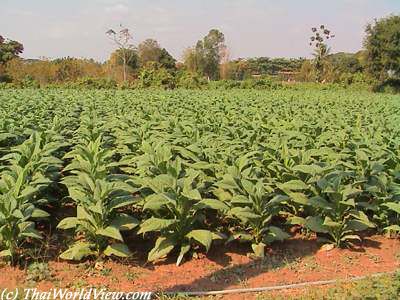
Tobacco fields
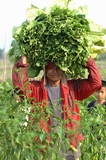
Such big leaves are main characteristics of tobacco fields.
In tobacco farming there is need to use insecticides that cause illness to people.
Each time farmers harvest and sell tobacco crop, a part of the money go in hospital bills!
A local saying argues that a tobacco farmer dies slowly year after year.
During decade 1980s,
some movements professed principles based on self-reliance and agricultural
old customs. These movements criticised the governement policy for favoring
fast economic growth through monoculture and industrialisation.
His Majesty The King was already putting the stress on growing produce first to satisfy its own
needs (and only later to sell the surplus on the market) and that farmers should fortify
their collective power to negotiate better prices. Only after
1997 Asian crisis, his theory got wider audience.
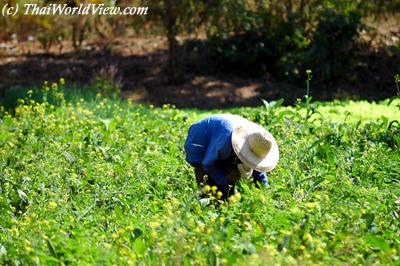
Farmer working
The King's theory hopes that community whose members
are self-reliant tends to have less trouble with crime, drug addiction, debts,
disintegrated families, migration, vote-buying, corruption.
Stronger communities shall benefit to the whole country, so Thailand would be able to
withstand crisis in the global world market.
The technique of swidden cultivation is to clear of land for cultivation
by slashing and burning the forest vegetation cover.
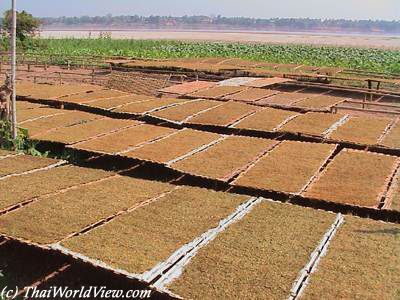
Tobacco
Around december, tobacco leaves lay under the hot sun.
They shall dry before being sold.
Cash crop monoculture is long term wrong solution as
farmers have always been at the losing end. They lack control over the prices
of agricultural inputs (seedlings, fertilizers, pesticides), of the crops they sell after
each harvesting season, and of the daily foods and consumer products they need.
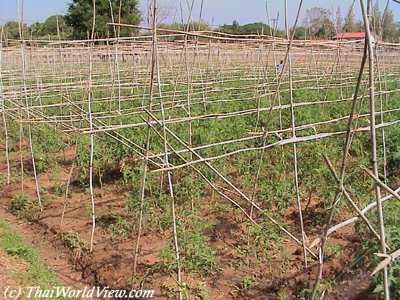
Tomatoes
In Sri Chiang Mai area, farmers cultivate tomatoes. Every year there is
even a feast called "GNAN MA KEUA THET"
(งานมะเขื้อเทศ) to celebrate this legume.
Some women make a living by weaving northeastern-style clothing at home.
In most parts of the Northeast, farmers, who are unemployed during the dry season,
take salted soil from their rice fields, add water to it and boil it down until crystals form.
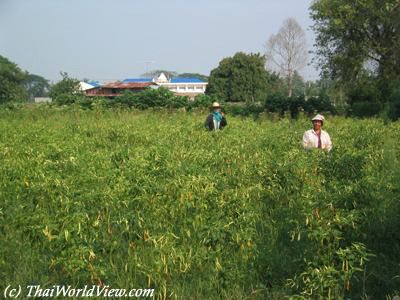
Pimento
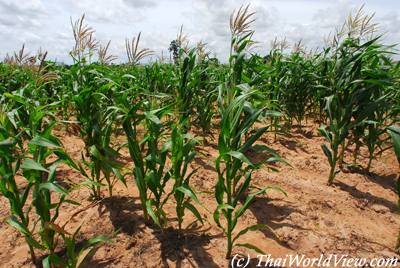
Mixed farming includes tomatoes, tobacco, cassava, pimento,
cucumbers, vegetables and orchard fruits such as pineapple, mangoes, guavas,
bananas and a variety of other fruit trees.
Commercial crops
Forests near villages have disappeared over the past 30 years.
The major factor has been the introduction of cash crops.
Commercial crops
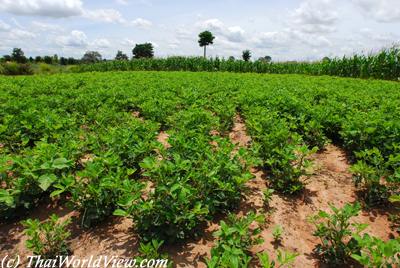
Fish ponds, fruit trees and vegetables and other crops are the solution
against monocultural farming.
Commercial crops
Villagers used to assist each other during stages of rice growing.
Help was needed during transplanting, harvesting and threshing.
Nowadays farmers rely on their family and hired labour.