Increase or decrease font size for easier reading :
A+A-
Isan is an agricultural area with
many paddy fields. Its farmers (ชาวนา)
are called "the backbone of the nation".
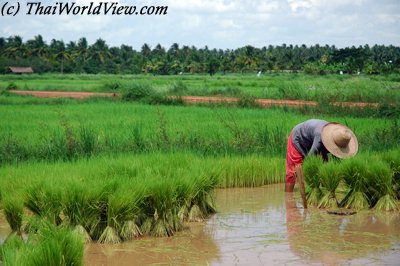
Working in paddy fields
Working in the paddy fields is a hard job. Only 70 to 100 Baht per day.
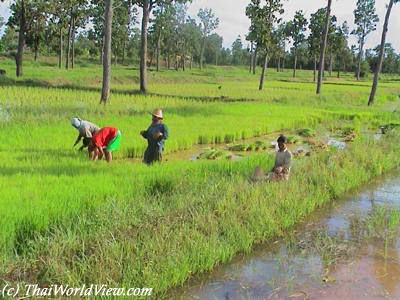
Farmers have to get up early at 6 AM. During the day they are working in a
hot muddy water. During the day their back is
bent because they are planting rice. They wear big hats to protect
themselves against the sun.
Thai mothers often remind their childen that
no rice seeds shall be left in a plate when eating. They shall not
forget the hard work of Thai farmers in the paddy fields.
Rice fields
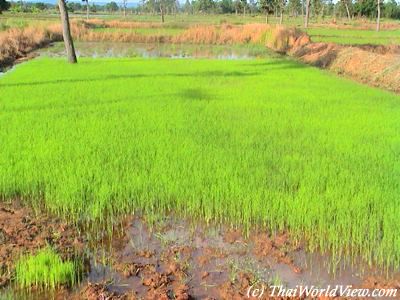
Paddy fields are filled with 30 centimetres of
water. A soil border closes each field in order to keep the water.
There are no snakes but leeches, which can be as long as a human finger
and as wide as three fingers if they sucked blood. There are also fishes.
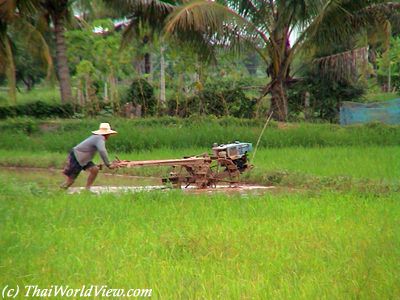
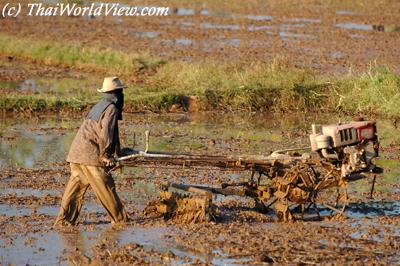
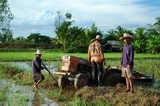
Farmers use a specific rototiller in order to smooth the soil.
Working in paddy fields
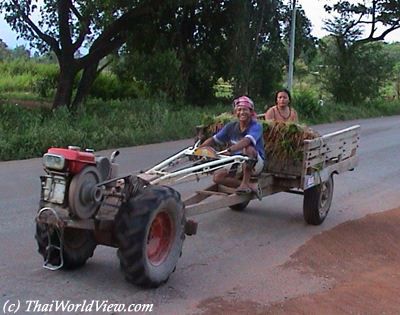
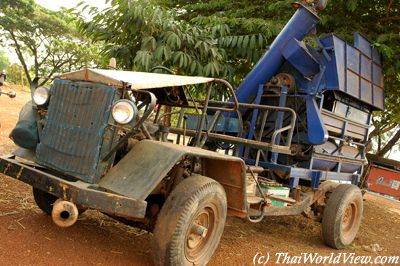
The rototiller is used in the paddy fields but also is used
as a vehicle when tyres are added to drive on the roads.
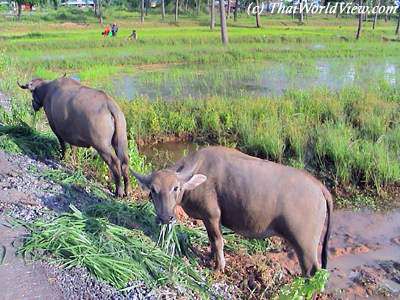
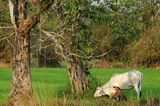
Buffaloes
Buffalos are not used anymore in the fields. They have been replaced
by the iron buffalos (ควายเหล็ก)
or rototillers.
Rice seedlings
Rice seedlings are gathered in one field where they grow.
When they are big enough, they are moved to another
field and planted with enough space to grow.
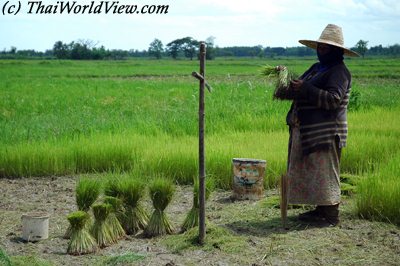
Rice seedlings
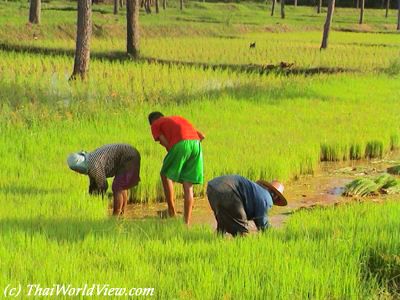
Before transplanting, the rice seedlings are pulled up, tied in bundle and planted.
It is always done by women.
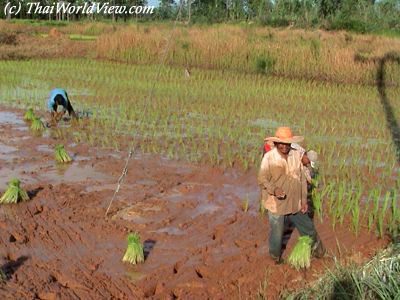
Transplanting
The farmers make holes in the mud and put inside
the rice plants. If the weather is too hot and water
disappears from the fields, harvest is bad.
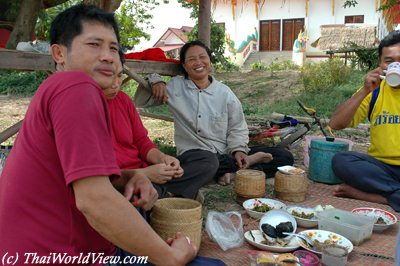
Lunch break
At the end of the day all farmers gather together around a Mekong bottle and an
energising potion in order to give force.
The rice season is from may to november.
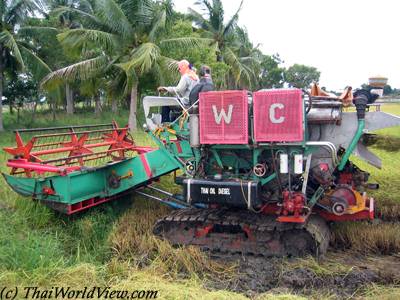
When the rice is yellow and mature enough, there are some harvesters
to extract it from the paddy fields.
Harvester
Those machines are very expensive, about one million Thai Baht. Some Thai
farmers rent them in exchange of a part of the harvest. People who
possessed such a machine became rich.
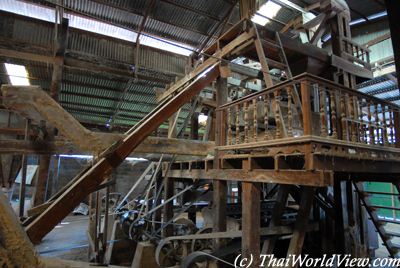
Threshing machine
Threshing, process to separate the grain from the chaff, used to be done by hand.
Threshing mobile machine
Threshing was a laborious process. Nowadays the job is done by a machine in a few hours.
Rice fields
Hom Mali, the famous Thai naturally
fragrant rice, is certainly the world's best rice. Hom Mali rice is
grown throughout the dry and salty Thung Kula Ronghai plain, which
spreads across the provinces of Roi Et, Surin, Si Sa Ket, Maha Sarakham
and Yasothon.
Despite the fact that Hom Mali rice can only grow once a
year and despite the lower yield than other rice varieties, it became
popular within northeastern farmers due to its attractive selling
price. It is also grown in other areas of Thailand. This rice yields
about 350kg of grain per rai in the Northeast, 500kg per rai in the
North and about 450kg per rai in the Central Plains.
Green rice fields
In 1998,
Thailand produced about 18.5 million tonnes of rice and exported some
6.37 million tonnes. Rice is cultivated on 56 million rai of land in
Thailand. Of this, 30 million rai is in the "ISAN"
with Hom Mali rice accounting for two million rai. In
1999 estimation are about 23 million tonnes
but only 5.3 million exported due to competition with other countries.
In 2003, Thai
farmers were bitter about the effort to develop jasmine rice or
Hom Mali flagrant rice from Thai varieties for
cultivation in the USA. For them, this was a case of bio-piracy.
Rice fields
In 2008, rice price increased sharply but it couldn't offset the doubling
of production costs (fertiliser, cost of diesel...).
Farmers' living standards and way of life are still the same but rice has become so precious that
farmers now have to guard their paddy fields day and night against theft.
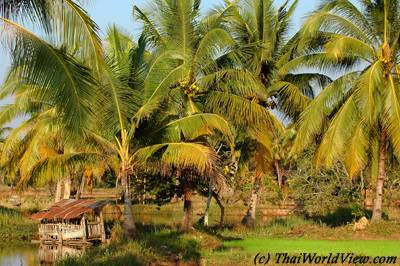
Shelter
A "HANG NA" ( ห้องนา)
is a shelter used by Thai farmers. At noon, they have a rest there as weather can
be very hot. It is also the place to have lunch together, a shady spot to smoke,
to talk. Such shelters disappear slowly as more machines are used so less farmers
are needed to take care about rice fields.