Increase or decrease font size for easier reading :
A+A-
งานบำเพ็ญกุศลฝังศพ
or "NGAAN BAMPHEN KUSON FANG SOP" is a Chinese ceremony in order to make
merit for the deceased person.
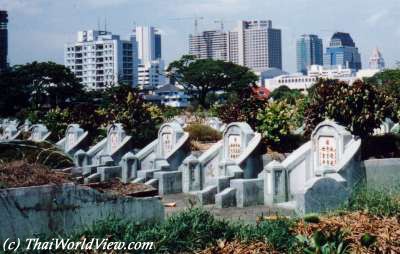
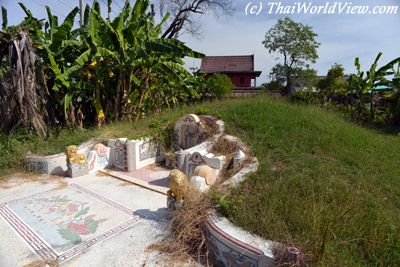
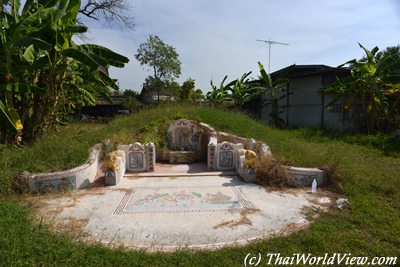
Chinese cemetary
In Chinese cemetaries, white graves are aligned. Chinese cemetaries are often
located on mountains.
During Chinese rites, funeral happen.
Cremation happens during Buddhist rites. The Chinese ceremony is called
"NGAN BAMPHEN KUSON FANG SOP".
A picture with all persons that did assist to the ceremony
is often shot. People are dressed in white robes during Chinese rites.
Such big picture, i.e. width one meter, can be seen in Thai houses.
Chinese cemetaryChinese cemetary
CHINESE OPERA
Chinese opera
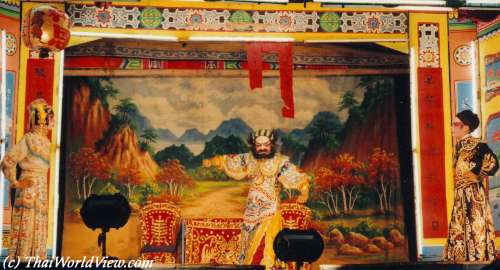
Chinese opera or theatre is called
"GNIOU" (งิ้ว) in Thai language.
Actors use Chinese language during "GNIOU" performances.
So when Thai people go to see Chinese opera, most of them don't
understand a single word but can enjoy the beautiful clothes,
the actors' lyric voice.
Chinese cemetary
Not so long ago, these theatres performances have popular success. It was an
opportunity to go out, to have some fun. But now these performances
are seldom. Younger generations prefer Thai or American movies.
But "GNIOU" performances are not dying.
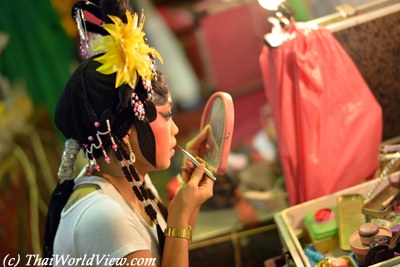
Now most actors are Thai actors coming from "ISAN"
(อีสาน - northeastern part of Thailand).
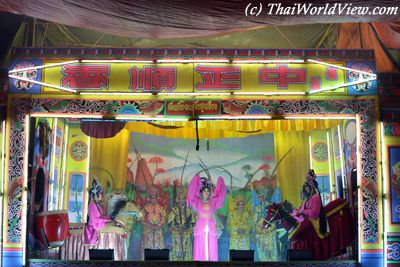
"GNIOU" performances are made to offer a gift to
Chinese gods. So now performances are often made in front of a non
living audience.
Chinese cemetary
During Thai festivals, there is sometimes a mix
of Chinese opera, "LIKAY" (ลิเก
- Thai traditional song and dance drama) performances, stalls with food, offering
to Chinese gods and to Buddhist statues.
Everybody go there, come back,
discuss. Don't expect silence. Anyway nobody is understanding.
CHINESE NEW YEAR'S DAY
Chinese New Year's Day
On the day before the
Chinese New Year's Day, Thai-Chinese people start to
make offerings to gods, their ancestors, the God of Land and the God of
Luck. Offerings include steamed duck, poached fish, chicken, pork heads, fresh or
canned fruit, Chinese cakes (often with durian) and vegetarian food.
"DOOK MAI CHIN" (ดอกไม้จีน -
Chinese flower) and golden paper are also offered.
For Chinese New Year's Day
there are parades with impressive dragons. When the dragon passes by
stores, the owner often lits crackers to ask for luck in business.
People set off firecrackers to scare off "evil spirits".
These crackers are 2 meters long and it takes more than one
minute for the complete explosion. Protect ears !
Chinese New Year's Day
On the Chinese New Year's day, family
members visit each other and give each other money red envelopes
called "ANG PAO". These envelopes contain money. On this day,
Chinese restaurants are very busy because all families are going out.
Chinese templeเทศกาลไหว้พระจันทร์
is the Chinese ceremony "TO PRAY THE MOON".
During the month of september, it's the
season for moon cakes. These are pies with durian, lotus seed,
chestnut or other fillings. It is called a cake but it is not a cake
from a western point of view (no cream, no chocolate).
This ceremony is coming from Chinese
history. When China was under the rule of Mongols, an insurrection was
prepared. Small papers giving orders were hidden in cakes.
YAOWARAT
Chinese temple in Udon Thani
In Bangkok, there is also a Chinatown area
("YAOWARAT" - เยาวราช).
The government hopes to turn "YAOWARAT", the home of the
biggest overseas Chinese community in the world, into an internationally
famous landmark. The goal is to promote Thai-Chinese culture and boost tourism.
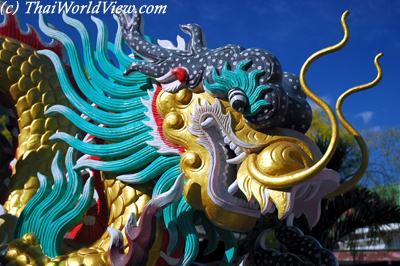
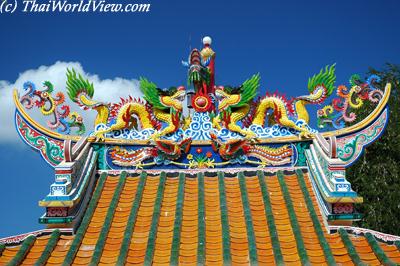
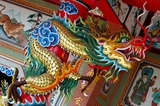
Chinese dragon"YAOWARAT" is easily recognisable because
all the shops signs are written in Chinese. In this area, there are streets
where all shops provide similar services: the streets about car motors and so
on... Of course many Chinese products can be found. There are also
four Thai newspapers in Chinese language.
The year 2002 marked Thai Chinatown's
110th anniversary. Most of Thailand's top companies,
including Charoen Pokphand Group, opened their first offices in the area.
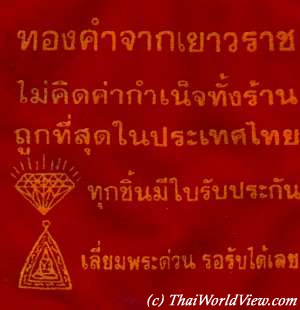
Red sack
All jewellery shops are owned by
Thai-Chinese people. The shop is always red, covered with
Chinese ideograms and inside many gold amulets, rings, laces can be
found. When a customer buy an item, the seller gives a little red sack.
Often in provincial towns, jewellery shops indicate that their gold is
coming from "YAOWARAT".
Chinese New Year is traditionally a time when
gold sells well. Yaowarat boasts of more than 100 gold shops along a 1.5 km stretch.
Chinese temple
In Thai movies, Chinese descendants are often represented
as shopkeepers, merchants, traders, factory owners, hotel owners, massage parlour
operators and bankers. An offensive term sometimes used is "JEK"
(เจ๊ก) for one of Chinese origin.
Another cliche is that Chinese descendants are clever and
hard-working, whereas genuine Siamese prefer to take life at ease
(สบาย-สบาย) to be lazy and big spenders.
Chinese dragon
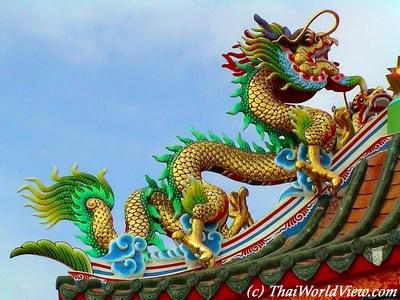
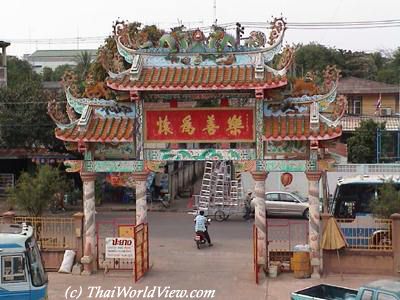
Local people believe that Yaowarat gate is the dragon's head and Yaowarat road
is the dragon's body.
KWAN YIM
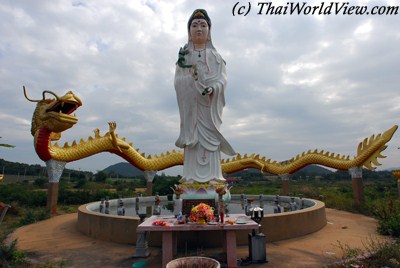
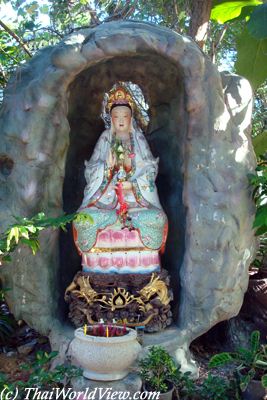
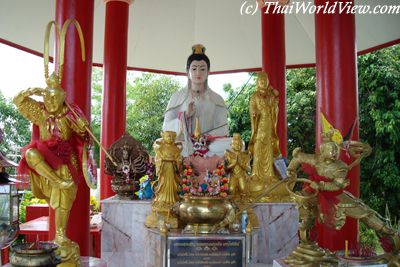
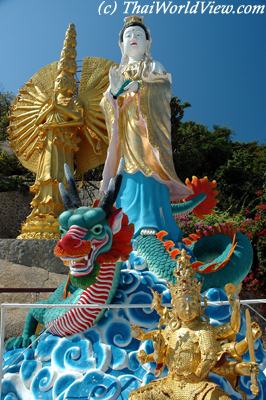
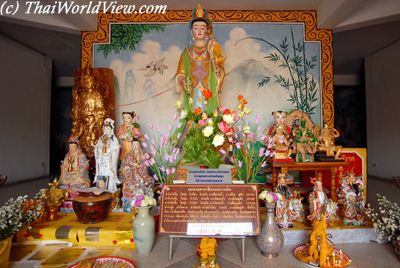
Kwan Yim"KWAN YIM" or เจ้าแม่กวนอิม is the
Goddess of Compassion. The dragon represents the wisdom or the guardian of wisdom.
Kwan Yim
Kwan Yim is much venerated by Thais of Chinese ancestory.
In her right hand is a flask from which issues an endless stream of compassion and mercy.
In her left hand she holds a willow branch, symbol of fertility.
Kwan Yim
The appereance of the Chinese Kwan Yim in the Thai pantheon
of important deities is an indication of the importance of the
Thai/Chinese community.
Kwan Yim
Kwan Yam is sometimes depicted in her multiple arms form.
It is said that she can have thousands of arms.
Kwan Yim
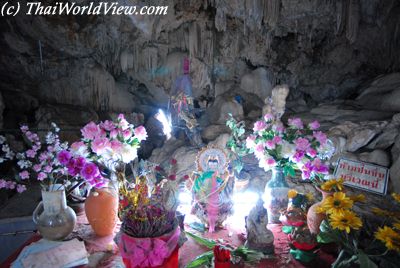
Kwan Yim statues can be found in dedicated Chinese shrines, in caves
but also in Buddhist temples.
Kwan Yim
Kwan Yin, the godness of Mercy, is usually depicted dressed all in white.