Increase or decrease font size for easier reading :
A+A-
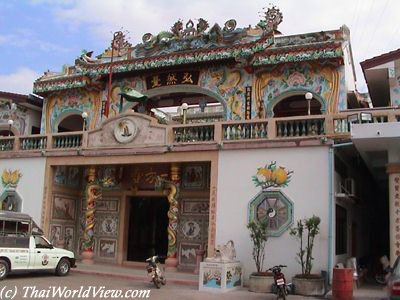
Chinese temple
In Thailand, many Chinese ideograms can be seen.
That is due to the fact that many Chinese
immigrants went to Thailand last century. The integration of 5 million
of Chinese immigrants by Thai society was a success due to
Thai people tolerance and a similar religious background.
Chinese
people are now well integrated in Thai society because they did not
remain all together. Many Chinese men or women marry Thai people,
so nowadays many Thai people have Chinese ancestors. On the contrary,
in Indonesia or Malaysia, Chinese people remained apart from the Islamic society.
In those countries, during riots, Chinese people are always blamed of economic
problems.
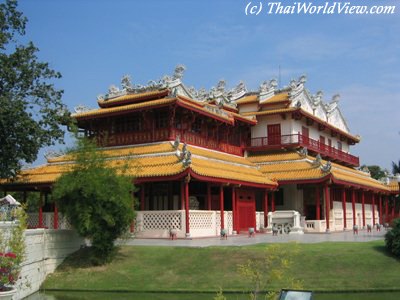
Bang Pa In
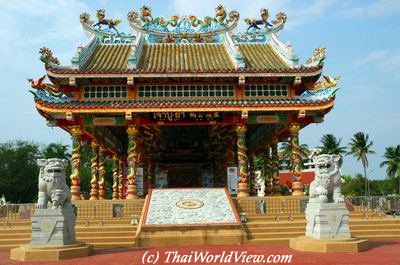
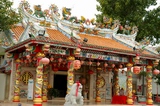
Many beautiful Chinese temples can be seen in Thailand
including inside Royal residences such as "BANG PA IN"
near Ayuthaya.
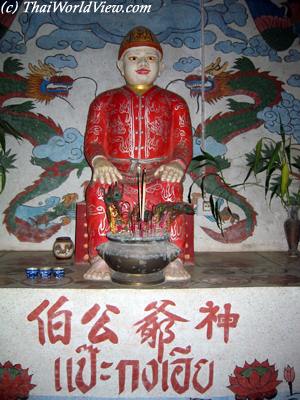
Chinese shrine
Chinese shrines are called "SAN CHAO"
(ศาลเจ้า) in Thai language.
Visitors are always welcomed in Chinese
temples (ศาลจีน) but they shall remove their shoes
at the entrance. Sometimes in Buddhist temples
("WAT" - วัด), a Chinese shrine can be found.
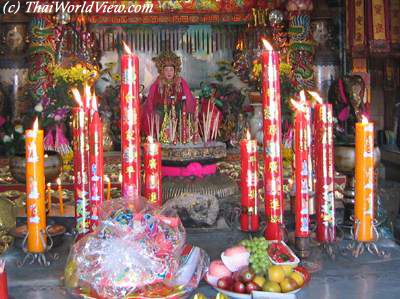
Chinese candles
Inside Chinese temples, it is darker than in Buddhist temples.
Inside there are big red candles decorated with Chinese
ideograms.
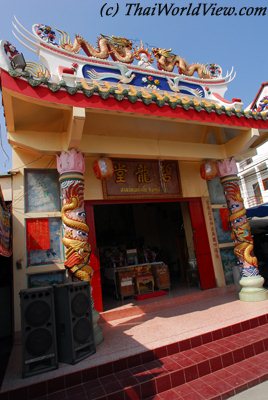
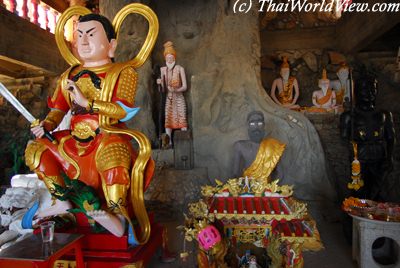
Chinese temple
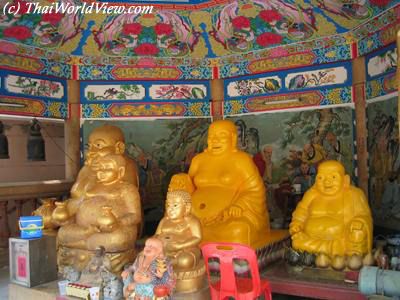
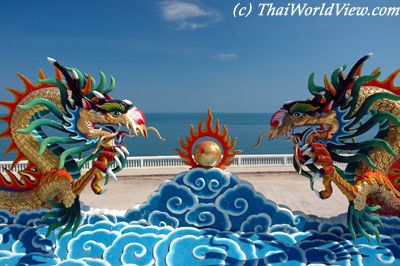
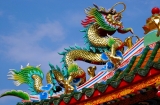
Chinese temples are colorful and decorated with
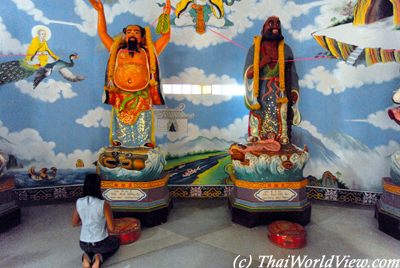
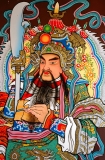
curved roofs, dragons and Chinese Buddha. One Chinese
representation of the Buddha is a man with a round belly, which symbolises
the opulence.
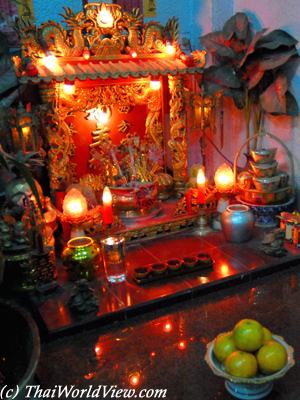
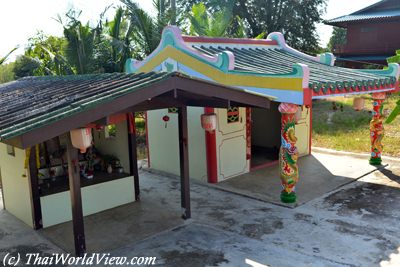
Chinese shrine
In some Thai houses, there is a small Chinese shrine to worship gods.
Even some Thai people, who have no Chinese roots, have also a Chinese shrine
at home. The shrine is usually red in colour and set on the floor. It represents the god
who controls the ground upon which the house is built. This shrine is called Tee-Ju-Iya.
The cult and respect of ancestors is the
base of the Chinese religion. So it fits well with Thai Buddhism, which
also respects ancestors and helps them to have a better next life in ceremonies
such as "KRUAT NAM" (กรวดน้ำ
- to pour water slowly onto the ground, so that the dead might benefit from
meritmaking).
Chinese shrine
Thai Buddhist people and Thai-Chinese
people make both donations to the temple but not in the same
way. Thai Buddhist people give food to the monks and hope to get a
better next life with such donations.
Thai-Chinese people
give food to the Chinese gods in temple. A pig head is offered for
key wishes. But on the contrary of Thai Buddhist traditions, people
are allowed to take the food back home (and to eat it!) when
the god has finished his meal.
Chinese temple
Thai children always support their
parents but it is said that Chinese children support their parents
better than any other children. Many Chinese people succeeded in
Thailand with their legendary habit of saving money and working
hard.
Chinese shrine
This Chinese shrine is located near a village spirit house occupied by
the village spirit ("CHAO PHO" - เจ้าพ่อ).
HISTORY
Chinese temple in Udon Thani
Many Chinese immigrants arrived in Thailand in
1870's.
After World War 2, there was suspicion over Thai people, who have
Chinese roots. Thailand bewared of red communist China.
Chinese temple
During years 1890-1910, Thai nationalism was very
sensitive with problems of lands linked to French and English imperialism.
The anti-foreign sentiment was also towards Chinese community.
Chinese immigrants were numerous, i.e. 10 percent
of Thai population was Chinese. First
immigrants did assimilate themselves in Thai society by marriage with
Thai people but the last immigrants came with whole families and did
not try to integrate themselves into Thai society. They continue to
speak Chinese, they send children in Chinese schools.
Chinese temple
So a new law in 1909 forced all citizens to
have a Thai surname. For example, if somebody is called
Santhi SAWAN, Thai people say "KHUN SANTHI",
foreigners say "MISTER SAWAN". In the past many persons
have the same name and it was not possible to differentiate them.
That's why in Thailand almost all
people have different surnames because when the law was enacted all
family has to find a different surname. Still today everybody call
each other with name. Surnames are only used for address or with
administrations.
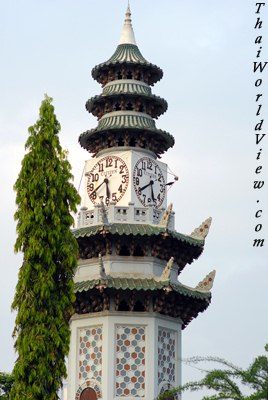
Chinese clock in Lumpini park
It is said that this law was also
directed against Chinese community in Thailand, i.e. they have to choose to
become Thai citizen with a Thai surname (i.e. they lost their Chinese
identity) or to remain foreigner and then outside of Thai society.
Most of all became Thai citizen.
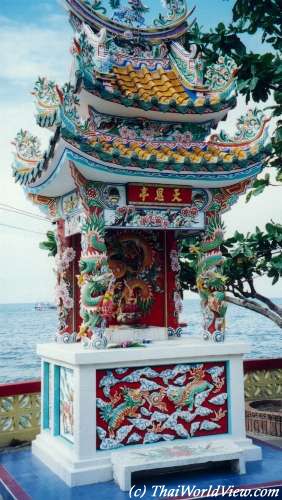
Chinese altar
Many Thai people still
have deep Chinese roots but nowadays Thai-Chinese people
are fully integrated and their Chinese roots are fading away.
The younger generations are deeply Thai and some young people
have difficulties to read Chinese ideograms. There are still
Thai-Chinese rich families that support their ancestors' old villages
by giving money to schools and so on...
The Chinese blood has
also helped Thai-Chinese businessmen to have contracts with China. It
is said that Thailand succeeded thanks to the Chinese blood, which gave
Thai people a better sense of business.
 Fly there with
Google Earth
Fly there with
Google Earth