Increase or decrease font size for easier reading :
A+A-
A Buddhist ordination takes place traditionally during two days.
The first day happens into the family circle and is related to the ordination preparation
("PHITI BUAT NAK" - พิธีบวชนาค).
The last day related to the ordination takes place in the pagoda.
Day One
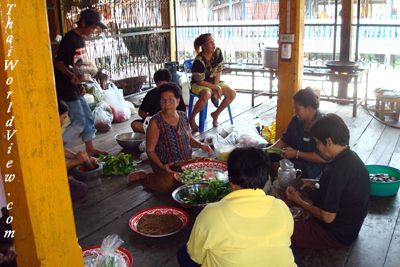
Dish preparation
The first day is called (วันสุกดิบ - "WAN SUK DIP").
People prepare dishes and desserts (ทำของ). People
help each other (เอาแรงกัน).
When their son is twenty years old, parents organize
a Buddhist ordination ceremony. As their son becomes a monk, parents receive many merits
or good deeds.
Shave hair
In a village, often two or three candidates become monks together
in order for the parents to prepare a big feast and share the costs.
Invitations (บอกบุญ - "BOOK BUN")
for ordination ceremony are
sent to relatives and neighbourhood. They are coming to help for the ceremony
preparation as it brings also good deed.
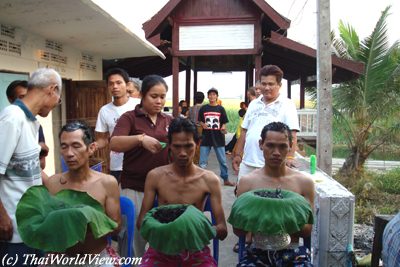
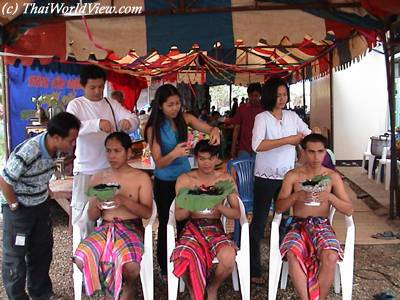
Shave hair
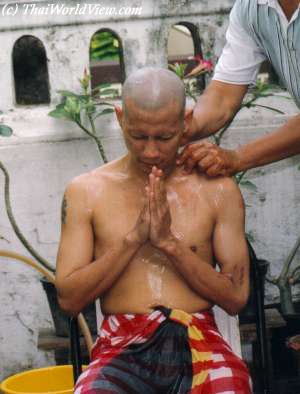
In the morning, the three candidates, chest bared, sit and hold a
bowl.
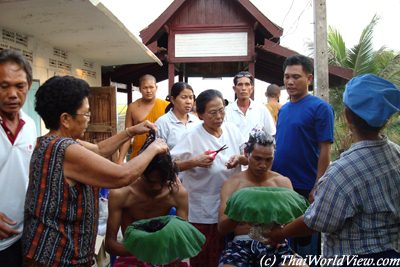
Head shaving
Then the guests and family members cut three locks of each
candidate.
Shaving head
The head is shaved. This is a renouncement to the beauty.
The eyebrows are shaved. Every member of the family cuts a lock.
Then a monk shaves the whole head.
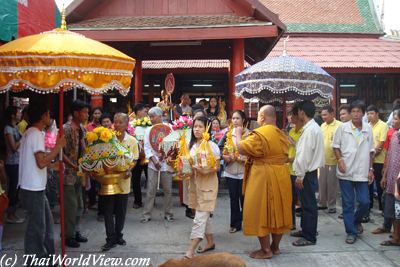
Then the first parade (แห่จากบ้านถึงวัด) happens.
It goes from the ordinand's home to the Buddhist temple.
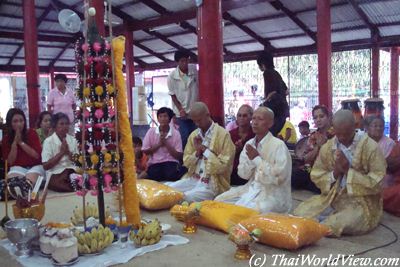
Purification rite
After the first parade, the ordinands, wearing their white clothes, with their family
attend a purification rite called "PHITI THAM KWAN NAK"
(พิธีทําขวัญนาค).
This Brahminic purification rite can be performed by a laic
("MO THAM KWAN" - หมอทําขวัญ) or a monk.
Purification rite
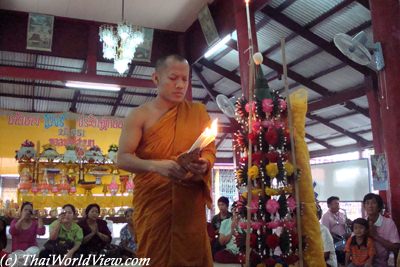
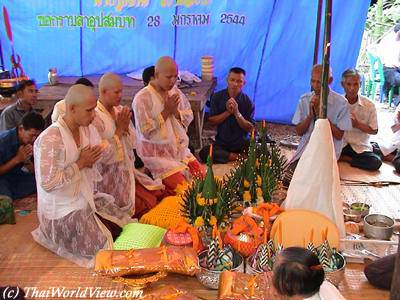
During this purification rite, a "BAI SRI" (บายศรี)
is used. This structure has a conic
shape and represents the deities' temple. it can have three, five, seven or nine stories, on
which offrands are placed.
The top includes an egg called
"KAI KWAN" (ไข่ขวัญ) and a candle.
An orange cloth is stuck to the vertical conical structure.
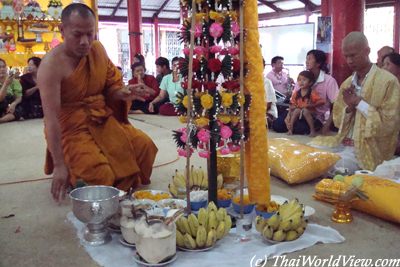
Purification rite
On the floor, coconuts, bananas, rice, Thai desserts are placed for the purification
rite.
This rite shall wake up the spirit
("KWAN" - ขวัญ) inside the ordinand in order
to purify his mind and heart to be ready for the Buddhist ordination.
Purification rite
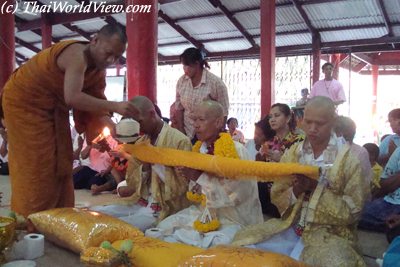
The ceremony master then gives the orange cloth to the ordinands, who will give it
to their parents.
Parents keep it in their home as an auspicious item.
Purification rite
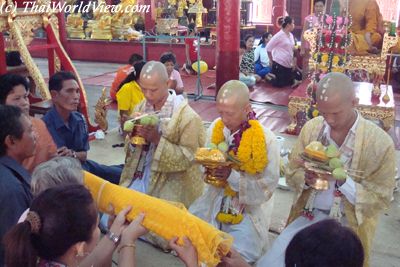
Ordinands eat a few cakes displayed on the conic structure and receive
a few white unctions on the head.
The ceremony master and the ordinands circumambulate around
the conic structure three times.
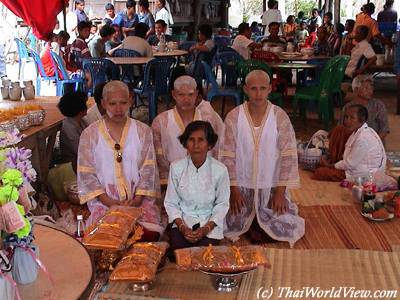
White clothes
The three candidates wear white clothes. It is a symbol of purity.
Guests are enjoying the meal and pictures are shot with the three candidates.
IIt is a great moment for a Thai mum to
see her children becoming monks. Moment of joy and pride.
Ordination
An old wise man say auspicious sentences for the three candidates.
In the north of Thailand,
the candidates are covered with gold, jewels and are called
"LOOK KAEW" (ลูกแก้ว).
Purification rite
Once the purification rite is over, the parade starts again to go back to the ordinand's
home.
The "YOM" (โยมพ่อและโยมแม่)
is usually the father or mother of the monk.
Paying respect
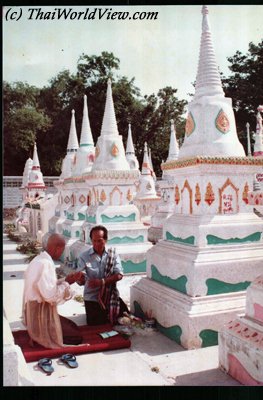
In the compound of the Thai Buddhist temple, the ordinand
also pays respect to his ancestors.
Day One evening
Prayers
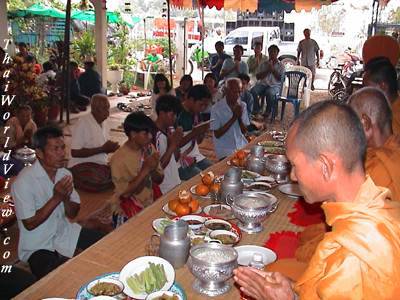
On the first day evening, the family invites monks at home
(การสวดมนต์ฉลองนาค) to tell prayers.
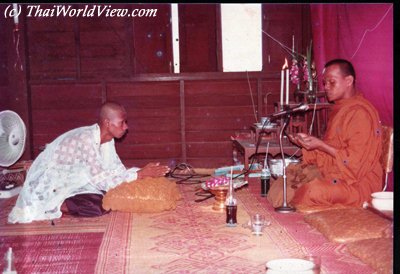
Prayers
The ordinand is listening carefully to the monks' evening prayers.
บวชพระ
or "BUAT PHRA" means to become a monk.
บวชนาค
or "BUAT NAK" means to prepare one-self to ordination.
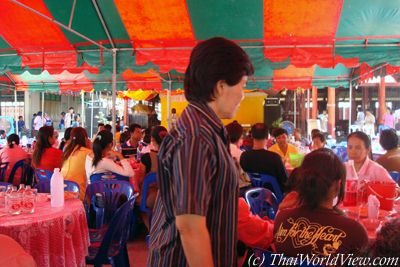
Evening feast
Revellers can rest and enjoy a nice diner. Sometimes there is music,
"LIKAY" or outdoors movies from 7PM to 3AM.
Evening feast
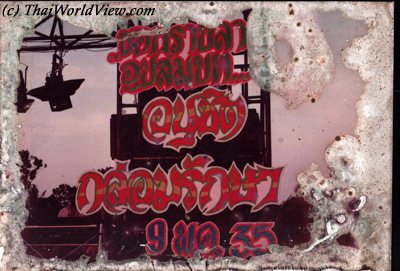
The name of the ordinand is displayed on the huge loudspeakers.
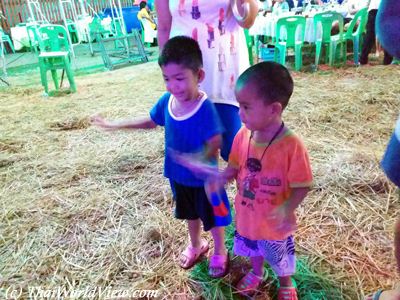
Evening feast
Kids have fun during the evening. There is nice food and funny entertainment.
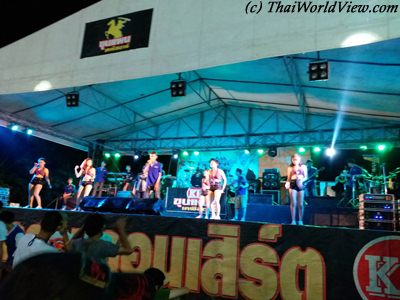
Evening feast
During this ordination ceremony event, local music and dancers are featured!